
How Do I Get a LOMA?
A step-by-step walkthrough of the Letter of Map Amendment process — what FEMA needs, how long it actually takes, and how to check whether a property near you has already gotten one.
Can’t get a LOMA, or still waiting on one? See what flood coverage would actually cost you →

What a Letter of Map Amendment Actually Is
A Letter of Map Amendment (LOMA) is a critical document that serves as an official amendment to the Federal Emergency Management Agency’s (FEMA) Flood Insurance Rate Map (FIRM). It is used to confirm that a property is not located within a Special Flood Hazard Area (SFHA) and is therefore not subject to the mandatory purchase of flood insurance. Obtaining a LOMA can significantly reduce insurance costs for property owners, as it demonstrates a reduction in flood risk.
What FEMA Requires, and How Long It Takes
To obtain a LOMA from FEMA, the property owner must first submit an application along with the required supporting documents. This typically includes:
- Property deed or legal documentation
- Elevation Certificates
- Topographic surveys
- Site plans or maps showing the property’s location in relation to the floodplain
Once the application is submitted, FEMA will review and assess the provided documentation to determine if the property is indeed outside the SFHA. The processing time for LOMA applications can vary depending on several factors, such as the complexity of the property, the accuracy of the submitted data, and the current caseload of the agency.
Under normal circumstances, FEMA may take between 30 to 60 days to process a LOMA application. However, this timeframe can be affected by several external factors such as natural disasters, government shutdowns, or an unusually high volume of applications. Additionally, delays can occur if the application is incomplete or contains inaccurate information.
To expedite the LOMA application process and avoid unnecessary delays, consider the following tips:
- Provide accurate information: Ensure that all information provided in the application is accurate and up-to-date. Pay close attention to details such as property measurements and elevation data.
- Gather required documentation: Assemble all necessary supporting documents before submitting the application. Missing or incomplete documentation will prolong the process.
- Follow up: Stay in touch with FEMA throughout the application process and respond to any inquiries or requests for additional information promptly.
- Online application: Property owners can submit a request directly to FEMA through Online LOMC. Licensed and certified professionals can use eLOMA to submit a LOMA request. See FEMA’s instructions for both application routes.
- Work with a professional: Hiring an experienced surveyor or floodplain management professional can help ensure that the application is properly prepared and all the required documentation is in order.
In conclusion, obtaining a LOMA from FEMA typically takes between 30 to 60 days. However, this timeframe can be affected by various factors that include but are not limited to the complexity of the property, the agency’s caseload, natural disasters, and government shutdowns. By providing accurate information, gathering necessary documentation, following up, submitting an online application, and working with a professional, a property owner can increase their chances of a smoother and faster LOMA approval process.
Below is a Conversation with a Client on BiggerPockets
Rental Property Investor from Lake City, FL
Just getting into my first rental. However, the flood insurance we are having to pay is a pretty hefty payment each month. I have been looking into petitioning for the removal of the requirement just solely to be able to increase monthly cash flow. If anyone has any tips on how to go through this process or the best way to increase your odds of being able to get out of it, your input would be greatly appreciated.
On a side note about this property. Every other house around it is not in the flood zone, and the only piece of the lot that is in the flood zone is a small area in the corner of the front yard. The house is also 13 feet off the ground and is no real danger of flooding (based on the 10-year flood plain).
Your Flood Nerd
Hi @Shawn Ziegaus, Have you tried shopping for your flood insurance on the private flood insurance market?
I suggest you Google (private flood insurance) or (Lloyd’s of London flood insurance) skip over the ads and look for an agent that will shop all options (including the NFIP or government option).
We do a free audit of someone’s current policy (and often find errors) as most agents don’t specifically deal with flood insurance and are not experts at how to get the best premium for their clients.
Moving the policy to the private flood insurance market, you might be able to save money.
How to Get a LOMA
Getting a LOMA (Letter of Map amendment) takes a very long time, and there is a trend that the government is not removing properties as readily as it did a few years ago.
We have also seen that properties are removed and then returned the next year.
VERY frustrating.
Anyway, there are a few things I can offer you to see if your home qualifies for the LOMA.

See if a LOMA Has Already Been Applied Near You
1First look up your property in this link
2Put in your property address
then on the right-hand side, there is a menu tool. Click on it to scroll down and look for the LOMA. Click it on.

This will turn on all the properties that have applied the address.

3Click on the download, and you will see the pop-up of what the result is.

See Open LOMAS
Look for the area that says OUTCOME and look to see if it says “Removed” or “NOT removed.”

How to REMOVE from Flood One
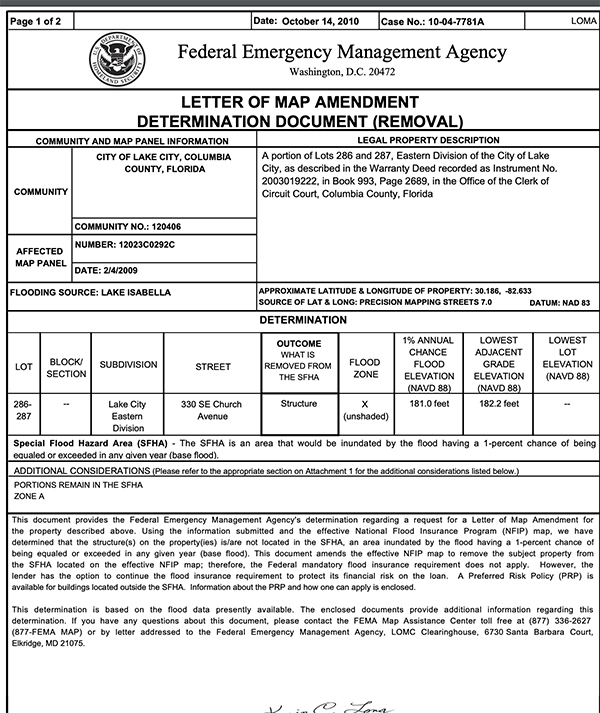
Why do a LOMA
NOTE: you will have to be patient the site is a bit slow, but if you wait for it to develop, you will be able to discover a lot about your area, so be patient.
You will need an Elevation Certificate.
You will need some “tools” to get the government to look at your property. You will need to get an Elevation Certificate (EC) (which needs to be done by a government-approved surveyor).
These can cost about $500 – $800, and most of the time, I have to help the surveyor. I can help point you to get one if you want. You can also google (your area and Elevation Certificate).
My thinking is that if properties have had success getting a LOMA around your property, then there is a good chance you might be able to get one as well.
If you don’t see any, then well, you might not be able to get one. So the private flood insurance market might be a better solution.
If your property is in just an A flood zone (like in the photo), there is a different way to go about getting the EC. If so put that in this thread, and I will try to explain what you can do in this instance.
Good luck.
Your Flood Nerd
Have a Flood Nerd check your LOMA odds first
Before you spend $500–$800 on an Elevation Certificate, get a real read on whether it's worth pursuing — free.
-
✓The multi-carrier shop$250 value
We compare the NFIP and the private carriers that will actually write your property — so your decision comes from a real comparison, not a menu of one.
-
✓The coverage recommendation$200 value
We estimate your real rebuild cost and tell you what we’d buy — including replacement cost where the market offers it for your property. If you’d rather carry less, that’s your call, and you’ll make it knowingly.
-
✓The fine-print flag$200 value
We read the policy jacket before we recommend it, flag the terms that drive most flood claims — waiting periods, contents valuation, caps, major exclusions — and show you where the rest lives.
-
✓A-rated carriers only$150 value
We place coverage only with underwriters rated A- or better for financial strength.
-
✓Lender-ready documentation$150 value
We prepare the policy file to your lender’s standards, so flood isn’t the thing that slows your closing — whether or not a LOMA is in progress.
-
✓One clear recommendation, ~24 hrsreal human
From a licensed Flood Nerd — and every recommendation passes a second Nerd’s review before it reaches you.
Our promise: if a LOMA and dropping coverage really is your best move, we’ll tell you that too. We sell both the NFIP and private — so we have no reason not to.
Coverage descriptions are general; the terms and exclusions of the issued policy control. Recommendations are based on the information you provide and the markets available for your property, and no statement here guarantees coverage will be offered or that any claim will be paid.

Can’t get a LOMA? Let’s at least see what the cost would be.
Send us the address. We'll tell you honestly whether a LOMA is worth pursuing, and show you what flood coverage would actually cost either way — no pressure.
Privacy & communication consent. Your information is never sold, and is used only to shop for flood insurance on your behalf. We're paperless — by submitting, you consent to texts and emails from Better Flood and Your Flood Nerds about your quote, policy, and relevant flood updates. You can opt out at any time. See our terms of use and privacy policy.
Estimates are drawn from real Better Flood quote data and are not a quote for your property. Coverage descriptions are general; the terms and exclusions of the issued policy control. Recommendations are based on the information you provide and the markets available for your property, and no statement on this page guarantees coverage will be offered or that any claim will be paid.