From brokers who write the NFIP

FEMA Flood Insurance: Explained by Brokers Who Actually Write It.

FEMA flood insurance is the NFIP — the National Flood Insurance Program — and we write it every week through the Write-Your-Own program, right alongside the private flood markets we compare it against. That means we can tell you what no government site and no ad will: what it really costs, what it really covers, when it's genuinely your best option, and when it isn't.

Flood Nerd punching flood water
We write itthe NFIP, through the WYO program
We compare itagainst the private market daily
Same priceFEMA sets NFIP rates — everywhere
Honest answersometimes FEMA wins. Sometimes not.
Featured on
Better Flood featured on Top Rated Local, The New York Times, Money, Investopedia, Bob Vila, Newsy, and RealEstateRama

What is FEMA flood insurance?

"FEMA flood insurance" is the NFIP — the National Flood Insurance Program — the federal government's flood policy. The two names get used interchangeably, but here's the actual structure: FEMA is the agency. It draws the flood maps, sets the zones, and administers the program. The NFIP is the program itself — the actual insurance policy. When someone says they have "FEMA flood insurance," "NFIP flood insurance," or a flood policy from a big-name insurer, they're almost always describing the same standard federal policy.

The program exists because of a market failure: by the 1960s, private insurers had largely walked away from flood as a peril — too concentrated, too catastrophic to price. So Congress created the NFIP in 1968 to fill the hole, and for more than forty years it was effectively the only game in town. That's changed. A real private flood market has grown up alongside it — which is exactly why the questions on this page ("is it worth it," "is there something cheaper") finally have honest answers instead of just "it's your only option."

How much is flood insurance through FEMA?

Whatever FEMA's pricing system says your specific property costs — and that number is identical through every agent and company in America. Under Risk Rating 2.0, the NFIP prices each home individually: distance to water, elevation, foundation type, first-floor height, rebuild cost, coverage amount, deductible. There's no cheap desk and no expensive desk for the NFIP — the premium follows the property, not the logo. That's also why some homes pay a few hundred a year while a nearly identical-looking home a street over pays thousands: the inputs are different, so the price is.

Two things follow from that. First, if an NFIP premium shocks you, the fix isn't calling another agent for "a better FEMA rate" — it doesn't exist. The fixes are checking the rating inputs (wrong foundation type, wrong coverage amount, and stale elevation data are errors we catch constantly), and understanding whether a legacy discounted rate under Risk Rating 2.0's glide path applies to you — those discounts are valuable and, once cancelled, usually gone for good. Second, the NFIP number only means something in context. Our flood insurance cost calculator shows what real quotes have run by state and city, and the section below shows why the NFIP price is the start of the conversation, not the end.

What does FEMA flood insurance cover — and what doesn't it?

A residential NFIP policy covers the building up to $250,000 and contents up to $100,000 — and those two caps, plus how contents get paid, are where most surprises live. The building side pays to repair the structure — foundation, systems, walls, built-ins — at replacement cost for a primary home. The contents side is optional, has to be added deliberately, and pays at actual cash value: your five-year-old furniture is paid as five-year-old furniture, not as new. Basements are covered only in a limited way — structural elements and essential equipment, not finished spaces or most belongings kept down there. And no flood policy anywhere covers vehicles; that's comprehensive auto coverage's job.

If your home would cost more than $250,000 to rebuild, the federal cap itself is a gap — and it's one of the most common reasons a private market wins for a specific home, since private policies can carry higher limits and replacement-cost contents. We keep a full side-by-side of what flood insurance covers, private vs. FEMA if you want the detail; the short version is that the federal policy is solid at what it does, and what it does has edges.

Does FEMA still provide flood insurance?

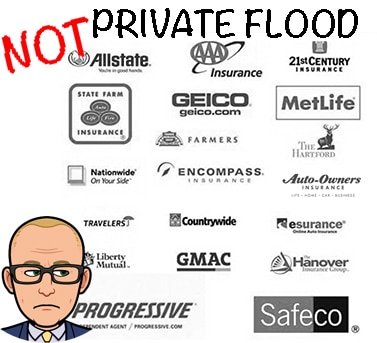
Yes — the NFIP is very much alive, and there are two doors into it: NFIP Direct, and roughly fifty Write-Your-Own companies. The WYO program lets private insurers sell and service the federal policy under their own paperwork — which is why flood policies from household names like Allstate, State Farm, and Progressive are, behind the paperwork, the NFIP. Same policy, same FEMA-set price, whichever door you walk through. If you've searched for "FEMA-approved flood insurance providers," that's what the list is: dozens of companies all selling the identical federal product.

We write the NFIP ourselves, week in and week out — typically through Selective, one of the stronger WYO partners we've worked with on service and lender documentation. The difference between our desk and a one-option desk isn't the NFIP policy — that's identical everywhere — it's what sits next to it: the entire private flood market, quoted side by side, so the federal policy has to win your home on merit rather than by default.

Is FEMA flood insurance worth it for homeowners?

For a lot of homes, genuinely yes — and this is coming from brokers who profit either way, so we have no reason to spin it. The NFIP wins outright in some very specific, very real situations: when you hold a discounted legacy rate that Risk Rating 2.0's glide path is protecting — leave, and it's usually gone forever. When the private market has no appetite for your property — certain foundations, certain claim histories, certain zones where private carriers simply pass. When you need the one policy every flood-compliance desk on earth recognizes without a phone call. In those situations we place the NFIP without hesitation, and we tell you that's the win.

And for a lot of other homes, the honest answer is no — a private market beats it on price, on limits above the $250,000 cap, on replacement-cost contents, or on all three at once. The frustrating part is that nothing about your home tells you which group you're in from the outside. The zone doesn't tell you. The premium doesn't tell you. Only the comparison tells you — which is the entire reason our desk exists.

The Flood Nerd POV: notice that no government website can write this section — FEMA is never going to tell you when its own program is the wrong buy, and it shouldn't have to. That's a broker's job, and it only works if the broker writes both sides. We do: the NFIP through Selective, and private markets like Neptune, Private Market Flood (TFIA), and Lloyd's of London. Every policy we recommend passes the same four checks — price in context, claim strength, lender acceptance, accurate coverage — and the NFIP wins those checks often enough that "FEMA vs. private" should never be a loyalty question. It's a math question, per home, per year.

What's the difference between FEMA and private flood insurance?

Those are the two types of flood insurance, and the differences are structural. FEMA's NFIP is one standard policy at one federally set price, capped at $250,000/$100,000 for homes, with contents at actual cash value and a roughly 30-day wait outside of loan closings. Private flood is a whole field of carriers — specialty markets, surplus lines, the London market — each with its own pricing models, its own appetite, higher available limits, replacement-cost contents options, and often shorter waiting periods. Neither is "better." The NFIP is the same answer for everyone; the private market is a different answer for every home — and which one wins is a property-by-property result that changes year to year.

We keep the full decision guide at private flood insurance vs. the NFIP and the coverage-by-coverage detail at what flood insurance covers, private vs. FEMA. Or skip the reading and see the thing itself:

The comparison a one-option desk can't run

The prices you were never shown

One house · one flood zone · same day

Zone AE · $250k
The quote they were shownNFIP — the federal default
$6,528/yr
Private market A🔒 never shown
$1,804
Private market B🔒 never shown
$565
Private market C🔒 never shown
$523
Same coverage. A 10× spread. Nobody hid these numbers — the desk that quoted the NFIP simply had nothing else on it. And on plenty of other homes, this exhibit flips: the NFIP is the cheapest line on the board. That's the point. You can't know without looking.

Real Better Flood quote comparison from one property. Your home will price differently — sometimes the NFIP wins. That's why we show you every line.

FEMA flood insurance questions, answered straight

What is the 50% rule in FEMA?

The substantial improvement rule: if repairs or improvements to a building in a high-risk zone cost 50% or more of the structure's market value, the building must be brought into compliance with current floodplain regulations — which can mean elevating it. It matters most after major flood damage or before a big renovation, and it's worth settling before you commit to either.

What is the 100-year flood rule?

A 100-year flood is a flood with a 1% chance of happening in any given year — not once a century. Over a 30-year mortgage that's roughly a 1-in-4 chance. It's the standard FEMA uses to draw high-risk zones, and it's why "it hasn't flooded in decades" isn't the safety signal it feels like.

What is the maximum amount FEMA will pay out?

Residential NFIP coverage caps at $250,000 for the building and $100,000 for contents — with contents paid at actual cash value, not replacement cost. If your home would cost more than $250,000 to rebuild, the NFIP alone leaves a gap; private markets and excess policies can cover above the caps.

Does FEMA pay if you already have flood insurance?

They're separate systems. With an NFIP policy, a flood claim is paid under the policy — that's the coverage working. FEMA disaster assistance is a different program that only exists after a federally declared disaster, and it isn't a bonus on top of insurance. Insurance rebuilds you; assistance is a limited safety net.

Will FEMA help if I don't have flood insurance?

Only in a limited way, and only if the flood becomes a federally declared disaster. Much of that assistance is loans that must be repaid, and grants are capped far below what rebuilding costs. Counting on disaster aid instead of a flood policy is the most expensive misunderstanding in flood.

How do I apply for FEMA flood insurance?

Through any agent or broker that writes the NFIP — NFIP Direct or one of the roughly fifty Write-Your-Own companies; the policy and price are identical everywhere. Plan on a roughly 30-day waiting period, with one key exception: coverage required by a lender at a loan closing can start at closing. We write it every week and handle it start to finish.

Does flood insurance actually pay out?

Yes — covered claims get paid every year, federal and private alike. Where people get burned isn't payout refusal; it's coverage set up wrong: contents never added, limits far below rebuild cost, basement belongings that were never covered to begin with. A policy review catches that before the water does.

What flood zone is my house in?

Look up your address in FEMA's Flood Map Service Center at msc.fema.gov — the official tool. Then treat it as a starting point, not a verdict: maps go stale, determinations get disputed, and Zone X doesn't mean water can't reach you — roughly a quarter of flood claims come from outside high-risk zones.

Who has cheaper flood insurance than FEMA?

For the NFIP itself, nobody — the price is federally set and identical everywhere, so shopping the NFIP against itself saves nothing. Private markets are the real question: they price each home with their own models and beat the NFIP substantially for some properties while losing badly on others. Only the comparison tells you which home yours is.

Why is Neptune flood insurance so cheap?

Neptune is a private flood market with its own underwriting models — when a home fits the model, the price can land far under the NFIP, which is the private market working as designed. For other homes it isn't competitive at all. Our full take is at our Neptune flood insurance review.

Want the NFIP? We write it. Want to know if it wins? We check.

Either way, you end up with the right policy: a real Flood Nerd prices your home through the NFIP and the private market side by side and tells you straight which one wins — with real numbers, not loyalty. We are not here to sell a policy. We are here to make sure you do not get flood insurance wrong.

Privacy and Communication Consent. We respect your privacy. Your information will never be sold or given to anyone else, except as necessary for the purpose of shopping for flood insurance on your behalf. We are paperless. By submitting, you consent to receive texts and emails from Better Flood and Your Flood Nerds regarding your quote, policy details, and relevant flood updates. Occasionally, we'll also share tips for making time with family more enjoyable. You retain the right to opt in or out of these communications at any time. Here is a link to the terms of use and privacy policy.

Scroll to Top